
How to Join Your Code 250 Sunset Valley Rail
We sell 5 different types of rail joiners to connect Code 250 (and Code 332) rail on your layout. All of the options below work across all gauges (O, Narrow, Mainline, Dual Gauge), all rail materials (brass, stainless steel, nickel silver, aluminum), and for indoor or outdoor layouts. Use two joiners/clamps per joint.
Quick Picker (what to use, when)
- Need electrical isolation? → Insulated Rail Joiners (plastic)
- Lowest cost, quick installs? → Brass Rail Joiners (slide-on)
- Connecting Code 332 to Code 250? → Brass Adapter Rail Clamps
- Most secure mechanical joint on Code 250? → Brass Rail Clamps or Split Jaw Stainless Steel Rail Clamps
Product Overviews

Insulated Rail Joiners
Notes: Plastic joiners that provide no metal conduction—feeders required on each isolated section.
Purpose: Electrically separate sections when running track power (blocks, detection, reversing, etc.)
Brass Rail Joiners (Slide-On)
Notes: Secure and highly conductive.
Purpose: Budget-friendly, simple way to connect rail ends on straights, curves, switches, and crossings.


Brass Adapter Rail Clamps (Code 332 ↔ Code 250)
Notes: More secure and highly conductive.
Purpose: Join taller Code 332 rail (e.g., LGB) to Code 250 SVRR rail. Reliable joint for high-stress areas (grades, tight curves, bridges) and harsh weather conditions.
Brass Rail Clamps (Code 250)
Notes: More secure and highly conductive.
Purpose: Reliable joint for high-stress areas (grades, tight curves, bridges) and harsh weather conditions.

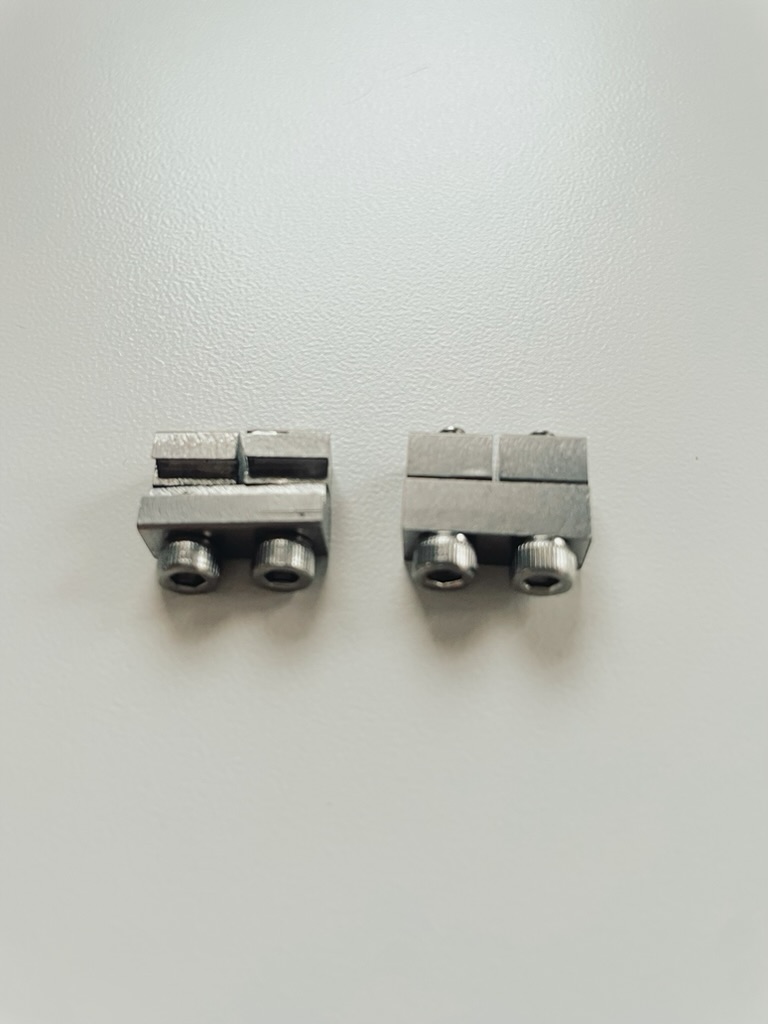
Split Jaw Stainless Steel Rail Clamps (Code 250)
Notes: More secure and corrosion-resistant; excellent for outdoor longevity.
Purpose: Long-life joint for harsh weather or high-traffic sections.
Installation Tips
- Conductive aid (optional): A thin film of conductive/anti-oxidant compound helps outdoor reliability.
- Tighten evenly: For clamps, tighten evenly—snug, not over-tight—to protect hardware and rail.
- Feeders: For track power, plan periodic feeders; don’t rely solely on mechanical joints for long runs.
- Use a rail clamp driver (3/32″ hex or 7/64″ hex) for easier install and more secure holds